
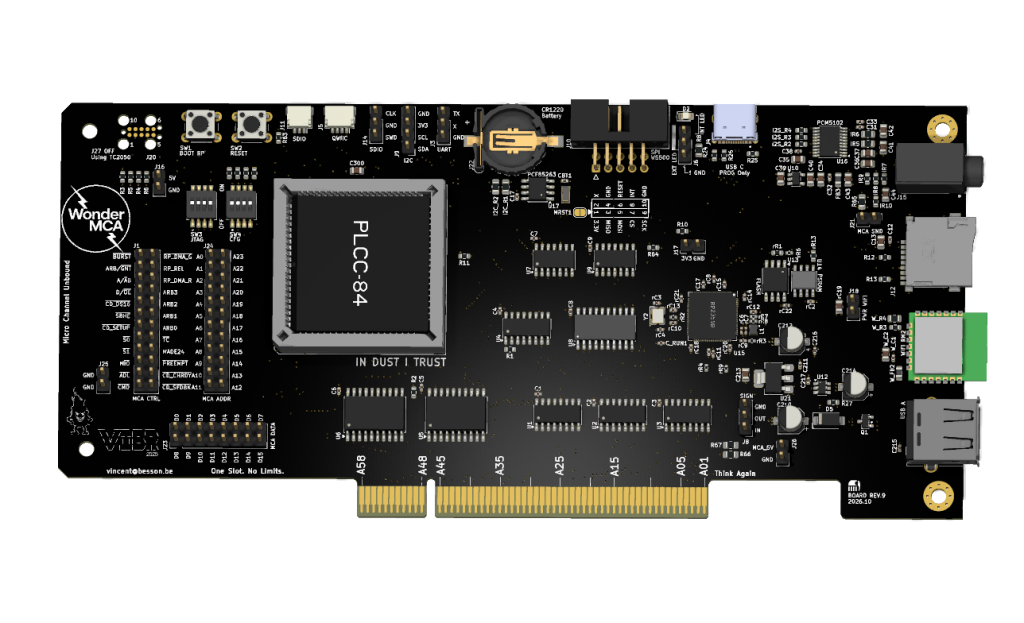
WonderMCA is an expansion card for IBM PS/2 Micro Channel machines, built around the RP2350 microcontroller from the Raspberry Pi Foundation. In the spirit of PicoMEM and PicoGUS, it brings modern, software-defined peripherals — sound, memory and I/O — to a platform that has been starved of affordable expansion cards for decades.
Special thanks to the support of FreddyV (father of the PicoMem), the WonderMCA benefits of 4 years of innovation and hard works directly from him, without forgetting Tubetime (Eric the father of the sound barker) for his guidance along this project.
The purpose of the WonderMCA is to bring Micro Channel Architecture machines proprietary bus with scarce documentation a powerful software defined solution with modern hardware. WonderMCA is a 16-bit single reprogrammable card that emulates the peripherals MCA owners want — and whose capabilities keep growing with each firmware release.
One Slot. No Limits.
Core Features
🔊 Sound
- Sound Blaster DSP emulation with real Micro Channel DMA — digital sound effects in DOOM, Wolfenstein 3D and friends, on machines that never had a Sound Blaster to buy
- AdLib / OPL3 FM synthesis (dbopl core)
- Gravis Ultrasound emulation with 1 MB wave RAM in PSRAM (in active development),
- General Midi — Plays out midi with the sound card emulation
- CD audio (Red Book) from BIN/CUE images, mixed into the output,
- Hi-Fi 3.5 mm jack (PCM5102 DAC) and routed to the MCA audio bus — hear it through the PS/2’s own speaker path.
💾 Storage
- Up to 4 bootable hard-disk images on microSD or USB storage, picked from the built-in BIOS setup — and create blank images (10 MB – 4 GB) right from the BIOS,
- Floppy emulation (A: and B:, every geometry from 160 KB to 2.88 MB) with write-protect toggles and hot-swap from the ScreenPad while DOS runs,
- CD-ROM emulation — ISO and multi-track BIN/CUE images with CD audio, hot-swappable without a reboot,
- Boot from CD (El Torito & MSCDEX) on machines a decade older than the standard.
🌐 Network
- NE2000-compatible network card emulation — works with standard DOS packet drivers,
- Over Wi-Fi (on-board RM2 module) — your PS/2 on the LAN with no cable,
- Over USB Ethernet dongles (CDC-ECM, ASIX AX88772, RTL8150),
- Wired W5500 SPI Ethernet module option via the expansion header.
⌨️ Modern input
- USB keyboard — injected into the PS/2’s real 8042 controller, so it works from the BIOS onward and respects your DOS keyboard layout,
- USB mouse — Emulate the COM2 UART port, works under DOS and Windows,
- USB Joystick — Connect USB Joystick (XInput, Dinput, Generic, Sony DualShock, Nintendo), Enjoy playing your favorite game with a USB Joystick,
🧠 Memory & system
- Native 4MB XMS emulation with the 8MB of PSRAM and works with systems providing 1 MB, 2MB and 4MB of RAM. XMS emulation is slower compared to traditional RAM but enable memory expansion to chassis without spare memory slot.
- Real-Time Clock (PCF85263) — correct date and time decades after the original battery died
- Native 16-bit data bus — support of 8 Bits or 16 Bits data bus via firmware revision and onboard dip switch,
🖥️ ScreenPad
- Optional OLED companion on the QWIIC I²C connector
- Live POST-code display and history — a built-in diagnostic readout for your PS/2
- Hot-swap floppy and CD images mid-session, adjust volume live, watch the network IP, set the clock — all without rebooting
🧠 Software defined
- Firmware updates over USB, CPLD update executed from the WonderMCA no additional programmer needed; new emulated devices arrive as software, not as another purchase.
- Native PS/2 integration — full option ROM at segment 0xD000, POS registers and ADF file, so the card is recognized and configured from the IBM reference diskette like any period adapter,
⌨️ Connected
- TagConnect, Qwiic, SDIO, UART, SPI, USB C & USB A — Large number of the board connector to add more devices to the WonderMCA in the future,
- Native 16-bit data bus — support of 8 Bits or 16 Bits data bus via firmware revision and onboard dip switch,
The Board
Every WonderMCA comes with 3D printed bracket on the back and on the front.
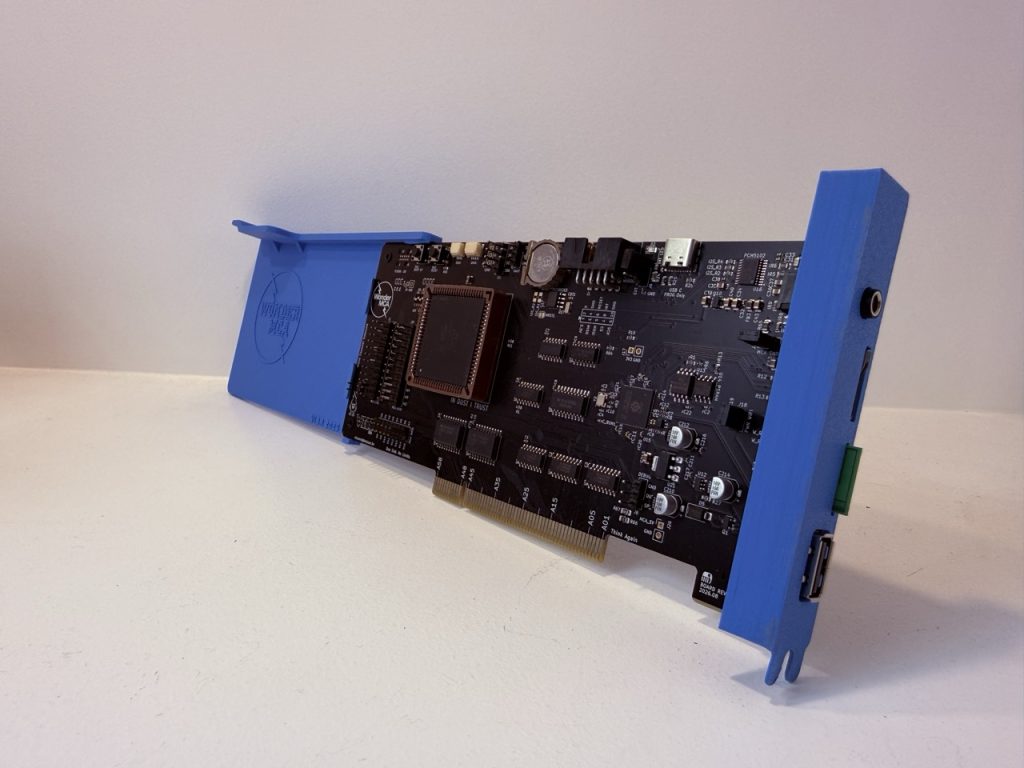
- ENIG Gold Plated and 30° Edge cut to protect the MCA slot pin
- 160+ Building parts
- RP2350 — dual-core ARM CPU running at 280 MHz, PIO state machines handling real-time bus cycles.
- RM2 WiFi Module (only for the Network Edition and Ultimate Edition)
- 8 MB QSPI PSRAM
- 16 MB FLASH
- ATF1508 CPLD (PLCC-84) — Micro Channel Architecture glue logic, with a TAG-Connect footprint for in-circuit reprogramming.
- SDCard to host Hard Drive, floppy, CD ROM Image
- RTC Real Time Clock with coin battery to keep track of DateTime
- Full 16-bit MCA data path — dedicated mux and bidirectional buffers, 5 V / 3.3 V level shifting.
- 4-layer PCB — solid ground and power inner planes, controlled 90 Ω USB impedance and a clean crystal zone
- USB-C for firmware update, USB-A to plug Keyboard, Mouse, Network dongle
- Screenpad (Ultimate Edition) — on-card OLED display for status, diagnostics and configuration without leaving the machine.
The ScreenPad
The ScreenPad is a front panel connected to the WonderMCA with 1.54’’ OLED Screen, 1 Rotary Switch, 4 LEDs and 4 Buttons. It comes with a 3D Print case, or it can be installed in a 3D printed floppy slot (not included) according to your PS/2 Model.
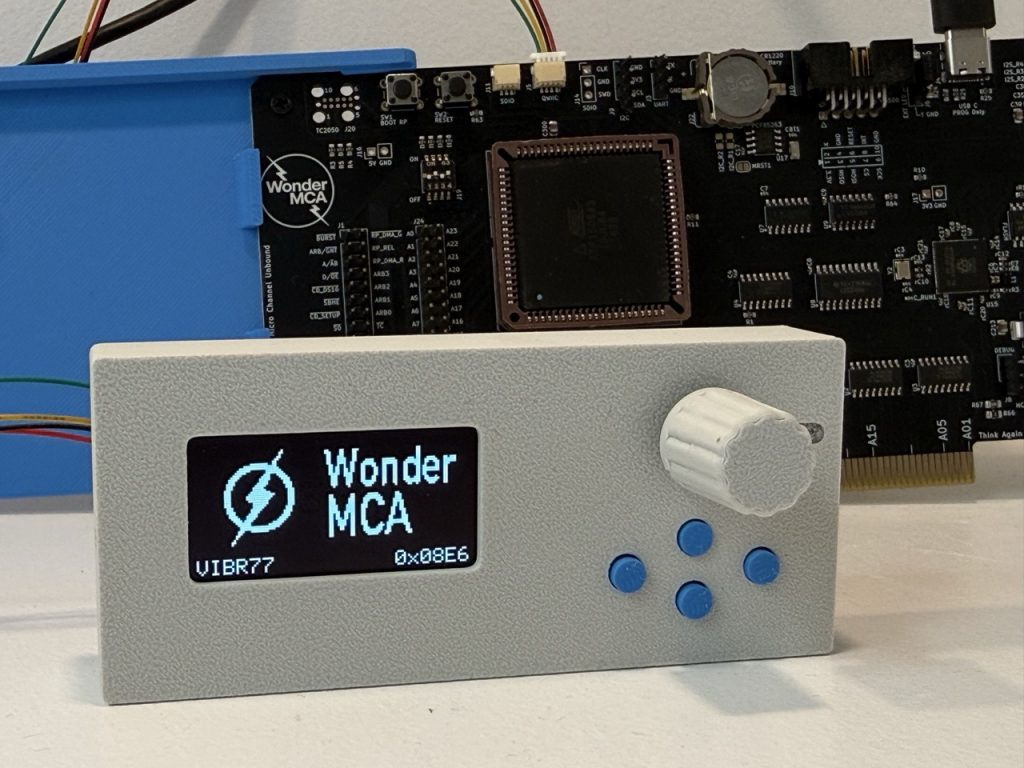
The ScreenPad is not mandatory but highly recommended to operate the WonderMCA and avoid entering the BOOT Rom menu each time a settings or a feature have to be modified or activated.
The ScreenPad is connected to the WonderMCA with a Qwiic cable making the use easy. It enables without rebooting or configuring the BIOS to:
- Switch mounted floppy or CDROM disk,
- Activate Network / Sound Emulation, control volume, mute, …
- Monitor the PS/2 Chassis, BOOT Checkpoint POST Code,
- Manage USB, activate USB Module on the fly
- Install CPLD updates easily
- More feature to be added as the WonderMCA evolves
| Standard | Network | Ultimate | |
|---|---|---|---|
| Storage Floppy Disk, Hard Drive, CD Rom | Yes | Yes | Yes |
| Sound Emulation (Adlib, Sound Blaster, Gravis Ultra Sound, …) | Yes | Yes | Yes |
| XMS Memory emulation | Yes | Yes | Yes |
| Boot Rom, firmware update, … | Yes | Yes | Yes |
| USB Keyboard, Mouse, Network dongle, … | Yes | Yes | Yes |
| RTC Real Time Clock | Yes | Yes | Yes |
| POST Code | Yes | Yes | Yes |
| Other features | Yes | Yes | Yes |
| Wi-Fi module | — | Yes | Yes |
| ScreenPad Module | — | — | Yes |
| Price | 169€ | 179€ | 209€ |
Prices are per card, shipping not included.
Market opening
Want one? Production boards are coming soon.