
Uncategorized

Uncategorized

WonderMCA – REV8 a new hope

On this project, I have so far made 2 prototype versions of the PCB, the REV2 and the REV5. The REV2 was a real draft with no CPLD to manage the MCA bus constraints, and it was a good base with all the MCA signals available on PIN Header to prototype what was supposed to be a solid version (REV5). The PCB Revision 5 is using an ATF1508 in PLCC84 format, and was supposed to be working smoothly but it was clearly not the case.

I made several mistakes on the Rev5:

  • JLCPCB 10K resistors wrong 0603 reference giving 1K8 instead of 10K,
  • TC2050 CPLD upload connector missing +5V from the board (as buried in the programmer reference document)
  • Wrong footprint on the LDO (Power supply) of the DAC circuit,

All these should be fix with the REV8 of the board… But it is not the main issue of the … Read the rest
Uncategorized

WonderMCA – Adding data bit on the BUS

Part of the REV4 revision of the WonderMCA board objective was to introduce 16Bit data Bus instead of 8Bit.All the PS/2 MCA Bus are able to handle 16Bits data slave along with 24Bits address lines. The expected outcome is to double the MEM & IO bandwidth and thus increase the native disk transfer.

The new board revision provides now 2 SN74CB3T3245DWR to cover DO-15 data lines, following the same multiplexing logic to the RP2350.

When D_OE signal is asserted (LOW), then A_OE is HIGH and the 2 SN74CB3T3245DWR are active to read or write data on the MCA bus according the cycle type (MEMR,MEMW,IOR,IOW)

Reading carefully the MCA sepcification the following new signals needs to be handle both by the CPLD and by the RP2350

  • /CD_DS_16n: This signal is an active LOW signal (Totem Pole), per MCA slot, slave driven, that defines when a slave is able to perform a
Read the rest
Uncategorized

DMA / Single player always wins…

A bet you can’t lose — and somehow did

Micro Channel arbitration is a tournament. Any device that wants the bus — a DMA controller, a bus-master card, the refresh logic — drops its 4‑bit arbitration level onto the shared ARB[3:0] lines during the arbitration window, and the lowest level wins. The lines are open‑collector and active‑low: you pull down the bits that are 0 in your level, you release the bits that are 1, and the wired‑AND of everyone’s drive settles to the winner. Lose a bit to someone with higher priority, and you drop out of all the lower bits too.

Here’s the thing about a tournament with one entrant: the single player always wins. When WonderMCA is the only card asking for the bus, its arbitration is a formality — present level 0001 (DMA channel 1), nobody contests it, the planar grants it the bus, … Read the rest

Uncategorized

WonderMCA part 4 – From silence to TADA – making Sound Blaster DMA work on an MCA PS/2

Why this was hard

When I started WonderMCA — a PicoMEM-style RP2350-based card for the IBM PS/2 MCA bus — the obvious “killer app” was Sound Blaster emulation. FreddyV has worked hard to bring the PicoMEM a working SBDSP emulator for ISA Bus; on MCA we get the same software base.

Except for one little detail: the DMA.

The whole point of a Sound Blaster emulation is that it streams 8-bit PCM sample data from RAM to the DAC without the CPU babysitting every sample. That stream goes through DMA (Direct Memory Acces). On an ISA Sound Blaster the DMA is pretty simple — there’s a single 8237 DMA controller on the chassis, you wire the card’s DREQ/DACK pins to one of its channels, and the controller’s hardware does the rest. Total mental load: 30 seconds.

MCA is not ISA. MCA has no 8237. MCA has CACP.

MCA

Read the rest
AppleII, SmartdiskII, Uncategorized

SmartDisk II – The Origin

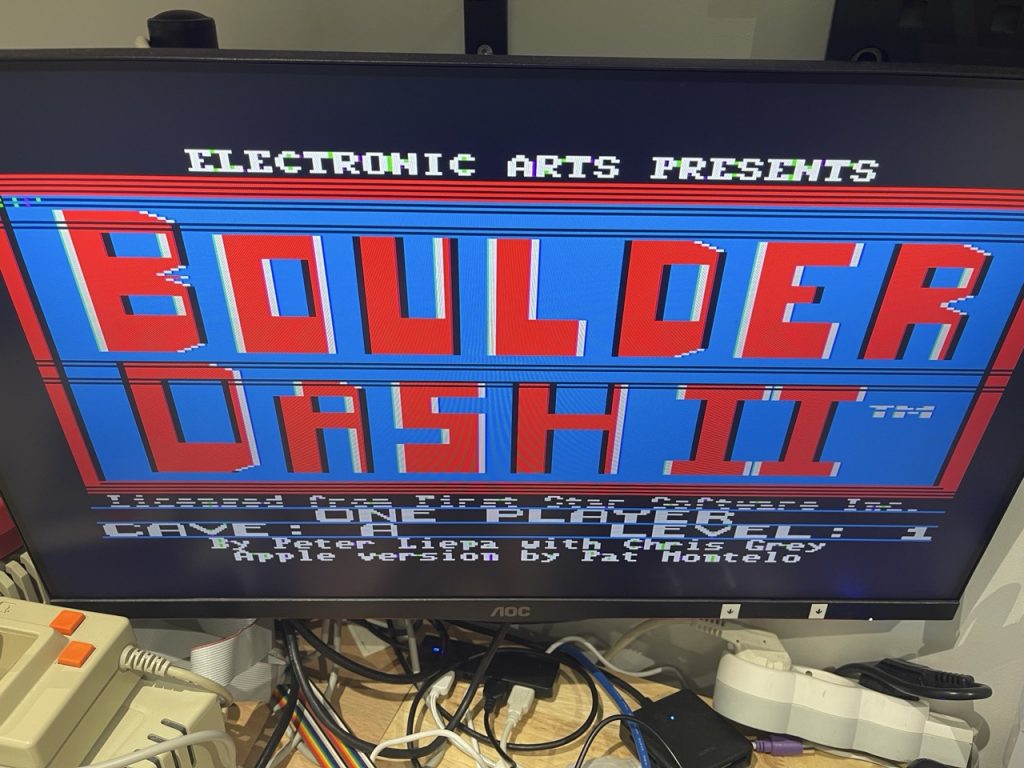
I remember the first time I had my first prototype of what will become the SmartDisk II loading the NIB image of BoulderDash II on my Apple II.

The first prototype was made on a very poor quality breadboard with a STM32 Bluepill, with a lot of ICs. The process to load NIB image was not really accurate, but I was so proud of having at least something working. 

This was the beginning of my journey to design and build an accurate Apple II Disk Emulator. I reached out to the Applefritter community for help on this project, and I received more than what I was hopping. This was a few month of long hardworking and debugging session with a lot of up and down along this way.

The purpose of this project was really a personal goal to experiment, learn, understand, and build. My approach from the beginning was … Read the rest

Scroll to Top